
Still waiting on your data analytics to create your strategy?
Waiting until tomorrow to know what happened today is no longer viable. While you are stuck on “calculating”, your competitors have already begun their strategy execution.
That is where real-time data analytics comes in. They fundamentally change the way you use your data for improvements.
In this guide, I will help you understand exactly what real-time analytics is. We will also explore why it matters and how you can implement it within your own business.
Ready to learn something new about the modern way of using your data? Let’s get started!
What is Real-Time Analytics?
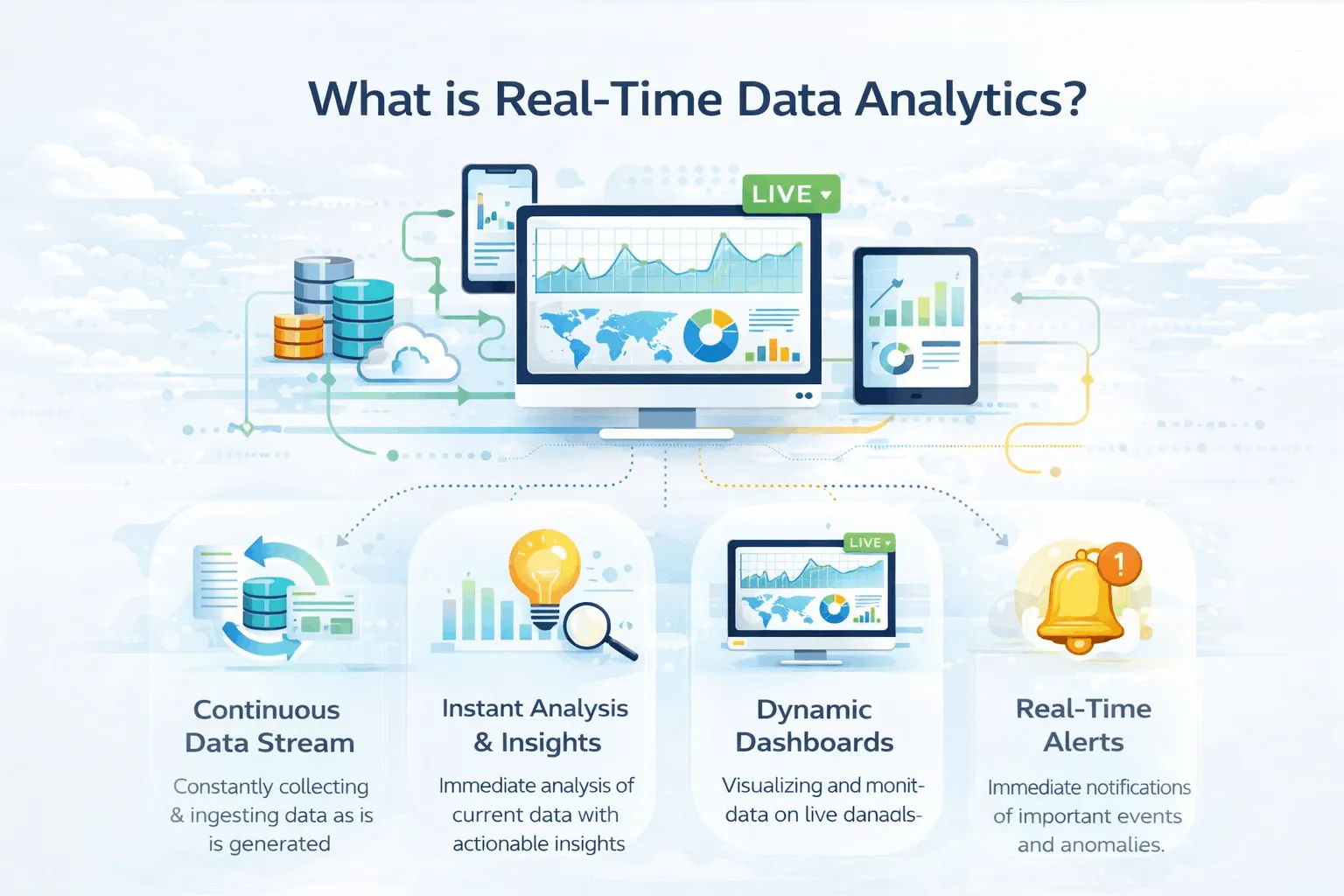
Well, real-time analytics is a simple concept where you not only process your data in real time but also analyze it as soon as it is generated. This is a big advantage because you do not have to wait days to receive results from your data.
You also do not have to run a batch process to receive results from your data. Instead, you receive them in real time. You can even use them to power your data visualization services.
This is a significant advantage because you can rapidly improve your strategy.
Comparing Real -Time vs. Traditional Analytics
Here is how using real-time analytics differs from traditional methods:
| Aspect | Traditional Batch Analytics | Real-Time Analytics |
| Processing speed | Hours or days | Milliseconds to seconds |
| Decision timing | After the fact | While it’s happening |
| Data freshness | Stale by the time you see it | Always current |
| Typical use | Historical reporting, trend analysis | Fraud detection, live monitoring |
| Infrastructure | Batch ETL jobs, data warehouses | Streaming platforms, event processing |
Key Benefits of Real-Time Data Analytics
So, how can real-time data analytics actually help scale your business?
The secret lies in its numerous benefits. These include:
-
Access to Instant Decision-Making
As data is continuously analysed, you or your team can detect issues more easily. This leads to looking for both risks and opportunities as they occur.
Moreover, this also helps in emergency situations. For example, a fraud detection system is useless if it can’t detect it in milliseconds.
-
Better Customer Experiences
Real-time analytics makes it much easier to detect buyer behavior.
This means that a customer adding items to their cart can be instantly prompted with a discount.
-
Higher Operational Efficiency
Monitoring your business in real-time can help you fix issues as they occur.
Sensors can use real-time data analytics to predict failures. They can even schedule maintenance before failures happen.
-
Competitive Advantage
It is always important to stay up to date with your competitors.
With this new method, you can optimize your pricing and launch media campaigns instantly.
To build faster streaming pipelines, teams often rely on ETL tools that support continuous ingestion and transformation.
Streaming Analytics Use Cases (By Industry)
Let us look at actual streaming analytics use cases observed across global sectors:
| Industry | Use Case | How It Works |
| Financial Services | Fraud detection | Analyze transactions in milliseconds to block suspicious activity |
| E-Commerce | Dynamic pricing | Adjust prices based on demand and inventory |
| Healthcare | Patient monitoring | Stream vitals directly to alerting systems |
| Manufacturing | Predictive maintenance | Monitor equipment sensors to predict failures |
| Transportation | Logistics | Optimize routes based on current traffic |
| Media | Personalization | Serve personalized content recommendations |
Implementation Strategy of a Real-Time Analytics Architecture
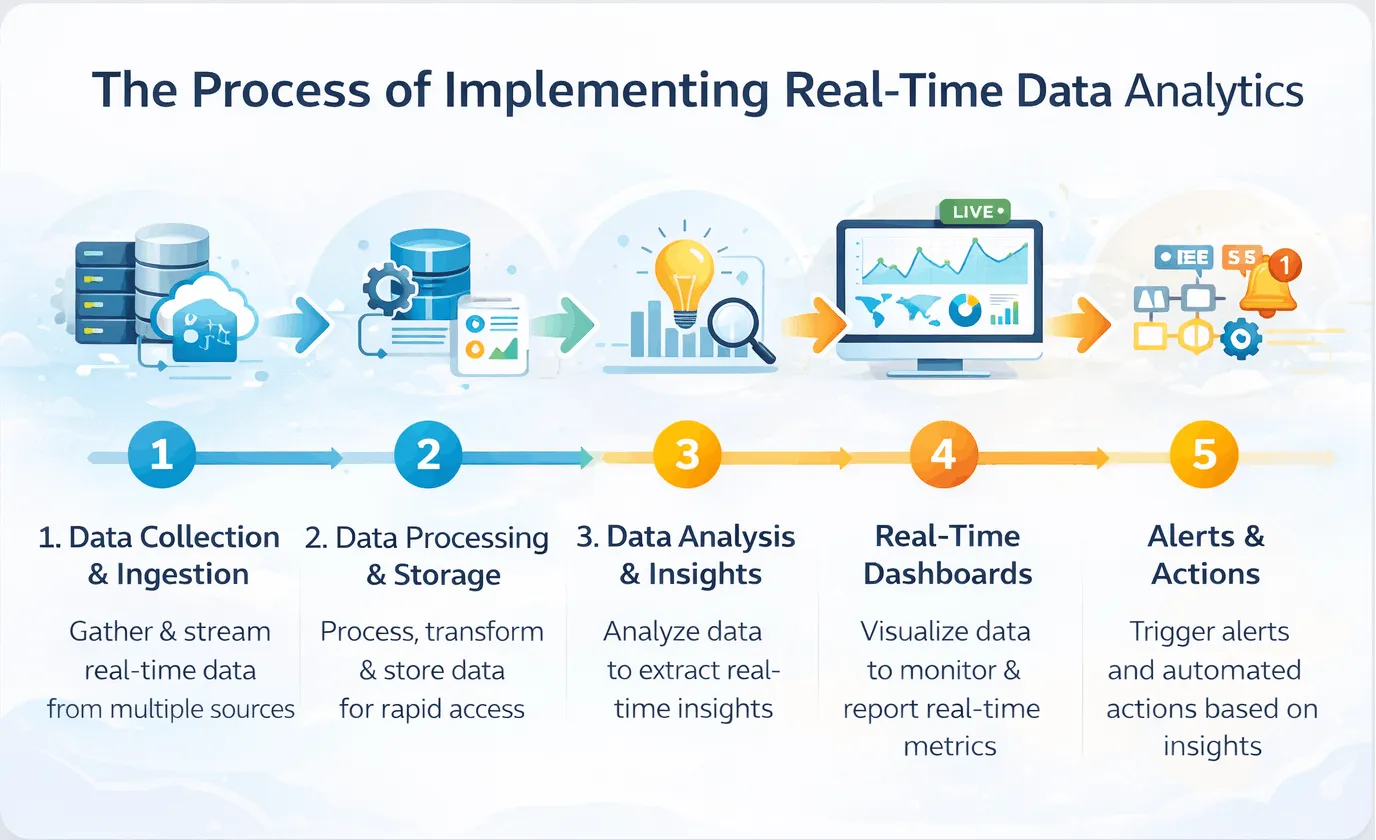
Looking to implement a strong real-time analytics architecture?
Ensure that you follow the steps I have mentioned below:
-
Identifying your best use cases
Never try to implement real-time analytics everywhere in your business.
Instead, consider prioritizing your needs. This means selecting high-priority use cases like:
- Fraud detection if you work in finance
- Inventory sorting, if you are in retail
- Monitoring equipment, if you are in manufacturing
-
Start With Change Data Capture (CDC)
CDC is a system that detects database changes and streams them straight to your central analytics system. This is the base foundation of any real-time pipeline.
Using CDC can help you detect changes in your business and reduce your overhead.
-
Building a Unique Streaming Pipeline
You can easily design a pipeline for your business using these layers:
- Ingest (Capturing Data)
- Buffer (Handling Throughput)
- Process (Transforming data)
- Serve (Loading data into dashboards)
-
Monitoring and Optimizing Data
Real-time systems require continuous monitoring to function properly.
Such monitoring requires tracking latencies and error rates. You will also need real-time alerts for any data pipeline failures.
-
Iterate and Expand
Successfully implemented your real-time data analytics system?
Now, it’s time to expand.
Continuously add more options to keep making your business easier to monitor and optimize.
A scalable streaming setup also depends on data migration frameworks that keep data movement reliable across systems.

Conclusion
Real-time data analytics are not something you can consider as an option. Instead, it has become essential to survive in the current competitive market.
For the best results, I suggest that you partner up with a dedicated expert. I recommend choosing Augmented Systems for your needs.
We have a team of experts who can help you select appropriate tools and strategies for a successful implementation. They can also provide you with helpful data visualization services.
Moreover, our strategies can help you build real-time analytics. We help prioritize the exact use cases you need to tackle first.
From architecture design to tool selection, the team at Augmented can handle every data challenge.
So are you ready to make your data work for you? Contact Augmented Systems today and get instant insights from your data.
Once live insights are available, using strong data visualization examples makes it easier to turn real-time signals into action.
FAQs
1. What is real-time data analytics?
Real-time data analytics is the process of analyzing data as soon as it’s created, within milliseconds or seconds. Unlike traditional batch processing that runs daily or hourly, real-time analytics lets you act on insights while events are still happening.
2. What are common streaming analytics use cases?
Popular streaming analytics use cases include fraud detection in banking, dynamic pricing in e-commerce, patient monitoring in healthcare, predictive maintenance in manufacturing, and real-time logistics in transportation—any situation where immediate action matters benefits from real-time processing.
3. How does real-time analytics architecture work?
A modern real-time analytics architecture includes four layers: data ingestion (using tools like Kafka), stream processing (with Flink or Spark), storage (often in data lakes with Iceberg), and serving (via APIs or dashboards). This pipeline processes data continuously with sub-second latency.
4. What are the best real-time data analysis tools?
Leading real-time data analysis tools include Apache Kafka for streaming data, Apache Flink for processing, Tinybird for real-time APIs, and cloud services such as AWS Kinesis and Google Pub/Sub. The right choice depends on your infrastructure, team skills, and latency requirements.
5. What industries benefit most from real-time analytics?
Financial services use it for fraud detection, retail for dynamic pricing, healthcare for patient monitoring, manufacturing for predictive maintenance, and media for personalization. Any business that can act faster than its competitors gains a significant advantage.