
As traditional data architecture struggles to keep up, modern changes are required.
You are probably struggling with similar data issues as well. Problems that force you to find your data every day across your sales, marketing, and finance departments.
To prevent this lack of organisation from harming your productivity, you need a better solution. Something that makes every department responsible for its own data.
Something that nullifies the need for a standalone central data team.
This is exactly what data mesh architecture aims to solve. Instead of centralising your data and hiring a team to perform checks, it puts your departments in charge of their own data.
Through this strategy, your central team bottlenecks are massively reduced. Also, it reduces confusion, as the team handling the data knows everything about it.
So are you excited to learn more about data mesh principles and benefits?
Let’s get started with a quick introduction to its basics.
What is Data Mesh Architecture?
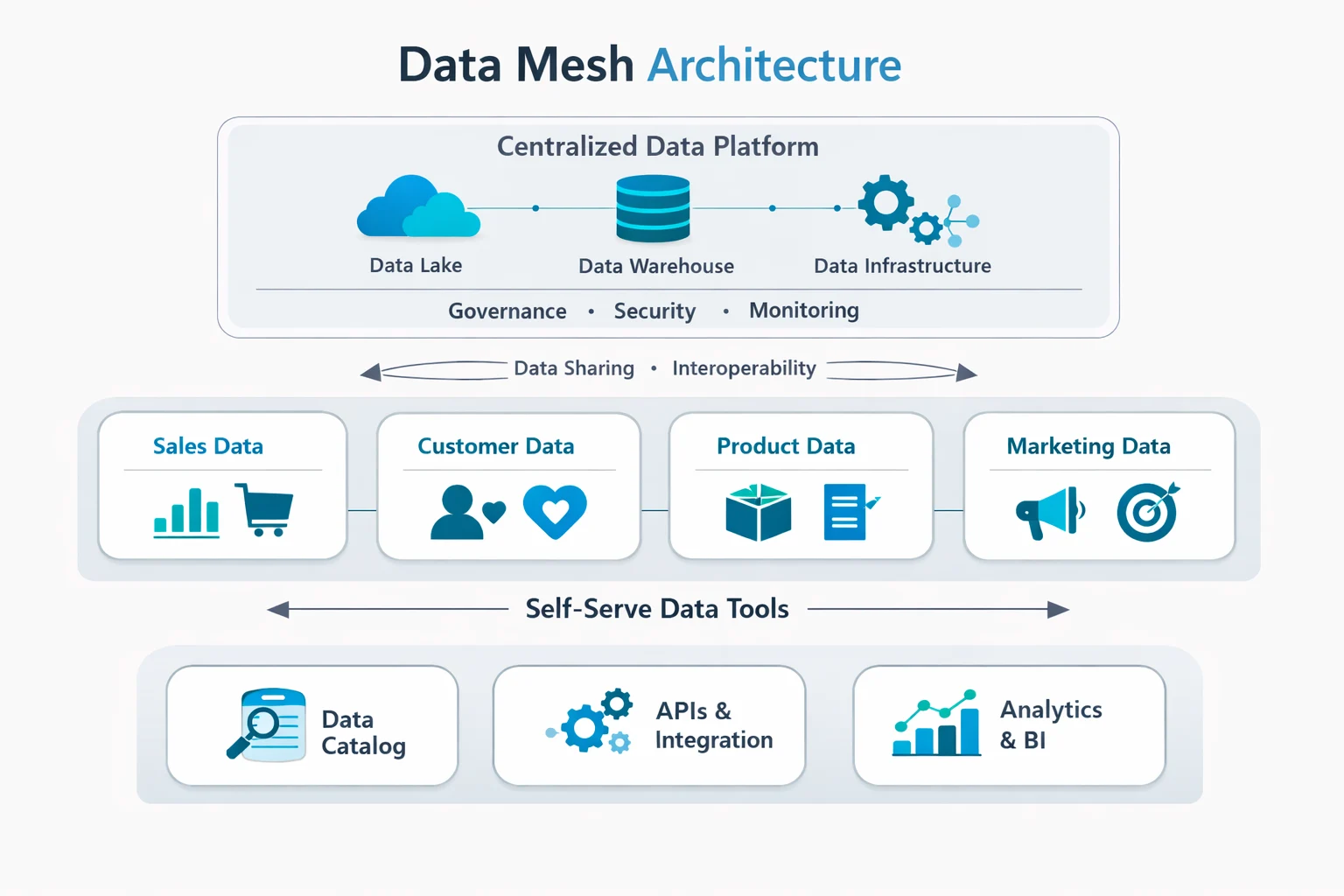
Data mesh is a decentralized approach to data architecture. It is an innovative concept that is quickly gaining popularity due to its significant improvements.
In this strategy, each domain team treats its created data as a product. These include domain teams such as sales, marketing, or customer service in your company.
As the teams both own and maintain their data, it eliminates the need for a central team. This minimizes confusion and develops a shared understanding between teams.
The 4 Core Data Mesh Principles
Any successful data mesh architecture depends mainly on these data mesh principles:
| Principle | What It Means |
| Domain Ownership | Each business domain is in charge of its data |
| Data as a Product | Data is treated like a customer product that should be quality assured |
| Self-Service Platform | Using a platform to help domains manage data themselves |
| Federated Governance | Implementing global standards on local domain data |
-
Domain Ownership
It is very important to let your domain teams take charge of their data. This shifts the pressure from a central team owning everything to letting the domain take ownership.
As sales manages sales data and marketing owns campaign data, productivity increases. It lets the people who understand the data best manage it as well.
-
Data as a Product
Domain teams treat their datasets much like any other company product. This means ensuring:
- Clear documentation of the data
- Ensuring its quality
- Providing easy accessibility
Such changes make your data products more trustworthy and easier to discover.
Make sure you use a smart approach to application integration to make this process easier.
-
Self-Service Platform
Using a self-service platform provides everything your domain teams require. It lets them both create and maintain their data without relying on a central team.
-
Federated Governance
Even though domains showcase autonomy, they will still follow your common rules. This means implementing global standards that ensure their regulation without sacrificing flexibility.
Why Should You Move to Data Mesh?
Companies usually adopt a data mesh architecture for reasons like:
| Challenge with Centralized Models | How Data Mesh Helps |
| The central team becomes a bottleneck | Domains work independently |
| Slow time-to-insight | Data products are available immediately |
| Poor data quality | Domain experts own quality directly |
| Rigid structures | Scales naturally with organization |
Data Mesh Implementation: How to Get Started
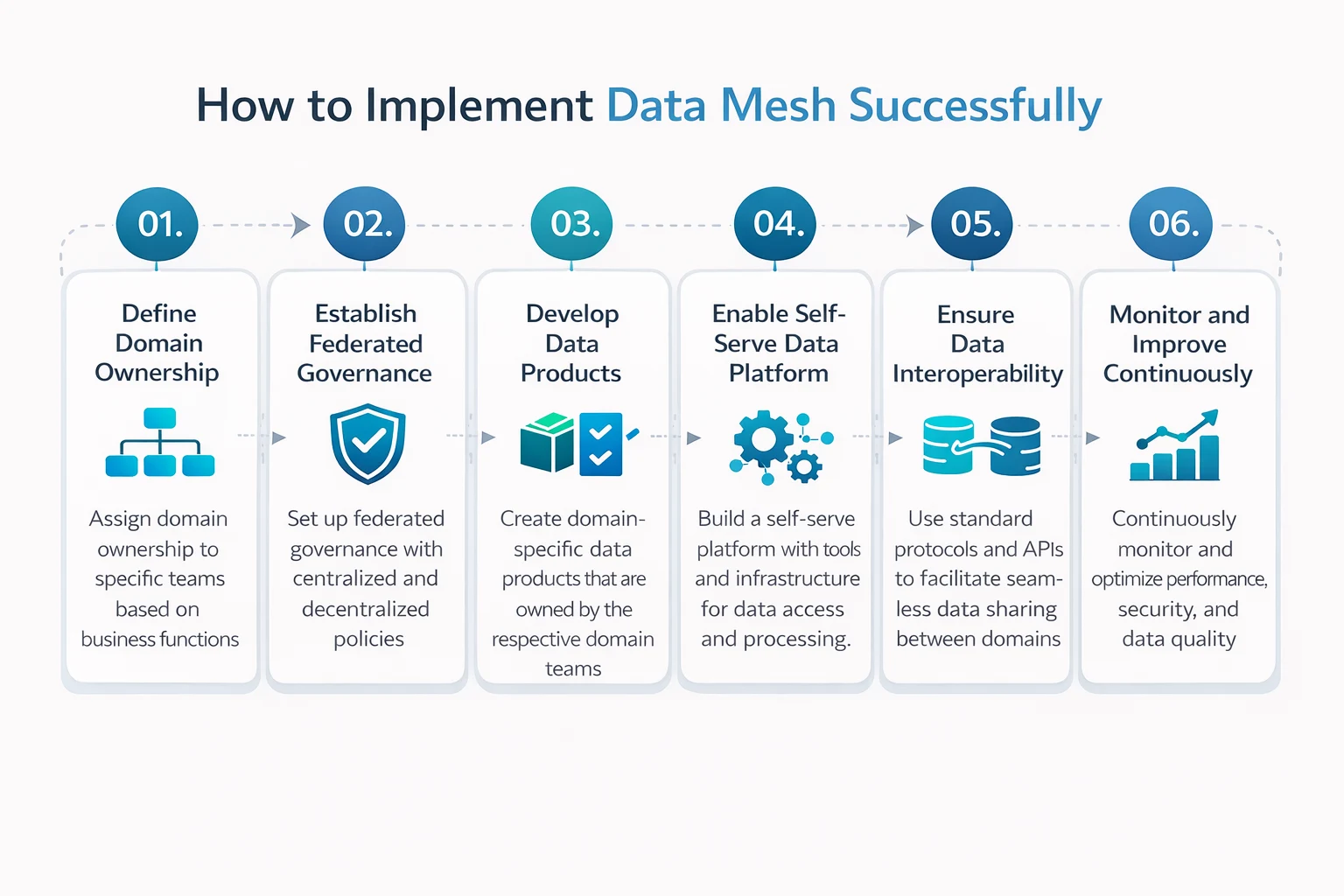
Every successful data mesh implementation is the result of following these steps:
Step 1: Identifying Domains
Start your implementation by identifying which business domains will benefit from data autonomy.
Ensure you choose only motivated teams already displaying clear boundaries.
Step 2: Establish Standards
Always define what a good data product should look like before your decentralization. This will ensure your team knows exactly what quality and accessibility you require.
Step 3: Builds Self-Service Platforms
Always invest in platforms that empower your domain teams. Do not prioritize apps that require a central IT infrastructure.
Step 4: Enable Domains
Your domain teams should be trained on efficient data product management. This will help them as they transition from data producers to managers.
Step 5: Evolve Governance
Your new governance should control access without disrupting innovation. Ensure your rules promote collaboration.
Data Mesh on AWS and Azure
Let’s understand how you should approach data mesh AWS and data mesh Azure:
Data Mesh on AWS
Your AWS services support data mesh capabilities like:
| AWS Service | Role in Data Mesh |
| AWS Lake Formation | Central governance, fine-grained access control |
| AWS Glue Data Catalog | Metadata federation across domains |
| Amazon S3 | Scalable storage for data products |
| AWS DataZone | Data discovery and sharing |
A key enabler for data mesh in AWS is also Apache Iceberg. This provides an open table format that makes data easily accessible.
Data Mesh on Azure
For data mesh Azure implementations, consider:
| Azure Service | Role in Data Mesh |
| Azure Data Lake Storage | Central storage for data products |
| Azure Purview | Data catalog and governance |
| Azure Synapse Analytics | Analytics across domains |
Microsoft experts clarify that you do not need a separate data lake for each department when using Azure.
Thus, you can easily tweak your Azure to let domains own their data products easily.
Data Mesh on Databricks
Using the Databricks Unity Catalog, you can provide universal governance across both data and AI assets.
It supports key data mesh requirements and can help you organize your independent workflows for better data intelligence.
Data Mesh Governance
As data mesh involves decentralization, governance can become tricky.
Make sure you use modern approaches and trends like:
| Approaches / Trends | Description |
| Data Product Contracts | Domains publish SLAs for quality, freshness |
| Federated Councils | Cross-functional teams set global standards |
| Self-Service Policies | Domains apply governance via templates |
| Platform-Centric Enablement | Governance as code embedded in the platform |
Common Challenges of Data Mesh Architecture Implementation
Integrating data mesh in your company can pose challenges like:
| Challenge | How to Address |
| Cultural resistance | Start with pilot domains, demonstrate value |
| Technical complexity | Invest in self-service platforms first |
| Governance consistency | Use federated councils |
| Cross-domain discovery | Implement enterprise catalogs |
| Access control | Leverage platform capabilities |

Conclusion
Data mesh architecture is truly a fundamental shift that can change how your enterprise handles data.
It overturns centralized control and promotes distributed ownership of data. While it may sound tricky, its actual implementation has a ton of new benefits.
Using data mesh in your company can lead to better innovations and improved data quality.
Ready to successfully implement data mesh architecture in your company? Let the experts of Augmented Systems provide you with the best strategy!
With years of experience in transforming company data architectures, we know exactly what you require. Our specialization in consulting global enterprises can surely make this data transformation a lot more efficient.
Let us help you break free from your data silos! Contact Augmented Systems today to receive the software consultation you require.
FAQs
1. What is data mesh architecture?
Data mesh architecture is a decentralized approach to data management in which business domains (such as sales, marketing, and finance) own their data and treat it as a product. It shifts away from centralized data lakes toward distributed, domain-oriented ownership.
2. What are the four data mesh principles?
The four data mesh principles are domain-oriented ownership, data as a product, self-service data infrastructure, and federated governance. Together, they create a scalable, decentralized data architecture that empowers domain teams.
3. How do I start data mesh implementation?
A successful data mesh implementation begins with identifying pilot domains, establishing clear data product standards, building self-service platforms, enabling domain teams with training, and evolving governance from control to enablement.
4. Can I implement data mesh on AWS or Azure?
Yes. Data mesh AWS implementations use services like Lake Formation, Glue Data Catalog, and DataZone. Data mesh Azure implementations leverage Azure Data Lake Storage, Purview, and Synapse Analytics. Both support decentralized data ownership within shared platforms.
5. What role does Databricks play in data mesh?
Data mesh Databricks implementations use Unity Catalog to provide unified governance across data and AI assets. It enables domain teams to manage data products while maintaining global standards and security across multi-cloud environments.